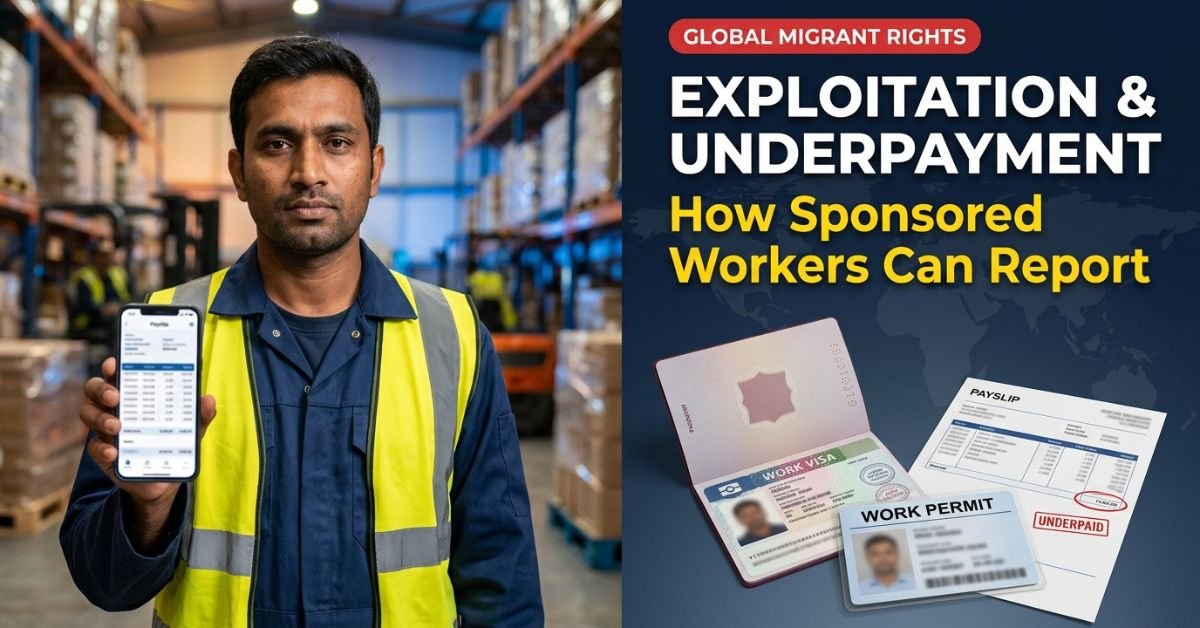
Exploitation And Underpayment: How Sponsored Workers Can Report Employers
Most sponsored workers who lose a case against a bad employer do not lose it in a hearing room. They lose it in the first week, by acting in the wrong order. When exploitation and underpayment finally become impossible to ignore, the instinct is to storm into the manager’s office or resign on the spot. It feels like taking control. In reality, it often hands the employer the evidence, the story and the timing.
Whether your visa was issued in Toronto, Dubai, Singapore, Berlin, Sydney or anywhere else, the pattern repeats. Your right to stay is linked to one employer, and that employer knows it. The good news is that almost every country that runs a sponsored work system also has laws against wage theft and forced labour, plus people whose job is to enforce them.
What you need is a sequence. This guide gives you one.
Quick Answer
Sponsored workers facing exploitation and underpayment should first secure their safety and copy all pay records, contracts and messages. Then contact an independent body a labour inspectorate, anti-trafficking helpline, trade union or migrant worker organisation before confronting the employer, and check filing deadlines, since visas are often tied to the sponsor.
Why The Clock Matters For Every Sponsored Worker
Three separate clocks start ticking the moment something goes wrong at work.
The first is your visa clock. In many countries, if your job ends, you get only a limited window to find a new sponsor, change your status or leave. Some systems allow a few weeks. Others allow a couple of months. A handful allow almost nothing unless you apply for special protection.
The second is your claim clock. Wage and employment complaints almost always have a time limit. It can be as short as a few weeks for certain disputes or as long as several years for unpaid wages, depending on where you work. Miss it, and a strong case can become a closed one.
The third is the evidence clock. Rotas get edited. Group chats get deleted. Colleagues who saw what happened move on or go home. The longer you wait, the thinner your proof becomes.
Keep all three in mind. Everything below is arranged around them.
Protect Yourself And Your Evidence
If you are in physical danger, contact the local emergency number now. That includes being locked in accommodation, having your movements controlled, or being threatened with violence. None of this is a workplace disagreement. It is a crime almost everywhere.
If you are safe, your job today is simple: preserve the record.
Save these today:
- ☐ Every payslip you have received, plus bank statements showing what actually arrived
- ☐ Your employment contract and the original job offer
- ☐ Your visa, work permit and any sponsorship documents listing your agreed salary and job title
- ☐ Rotas, timesheets, shift schedules or photos of clock-in screens
- ☐ Messages from managers or recruiters — especially any that mention your visa, your debts or “consequences”
- ☐ Receipts or transfer records for any fee you paid to get the job
- ☐ A private diary: dates, hours actually worked, what was said and who was present
Keep copies somewhere your employer cannot reach — a personal email account, a cloud folder in your own name, or a trusted friend’s phone. Do not rely on a work device or a phone the employer paid for.
Avoid these today: signing a new contract or “voluntary agreement” under pressure, signing anything in a language you cannot read, paying money to keep your sponsorship, or handing over your passport “for safekeeping.”
Identify What Is Happening To You
Exploitation and underpayment are not one thing. They show up in different forms, and each one tends to be handled by a different kind of body.
| Warning Sign | Why It Is Usually Unlawful | Who To Contact First |
|---|---|---|
| Paid less than the salary promised in your visa paperwork | Sponsors normally must pay the wage they declared to immigration authorities | Labour inspectorate or employment advice service |
| Hourly pay falls below the local legal minimum after deductions | Minimum wage laws apply to migrant workers too | Labour inspectorate |
| Charged for your own visa, permit or sponsorship costs | Many countries bar employers from passing these costs to workers | Employment advice service, immigration authority |
| Paid a recruiter or agent to get the job | Worker-paid recruitment fees are banned or restricted in many places | Police fraud unit or recruitment regulator |
| Threatened with visa cancellation to make you work longer | Using immigration status as leverage can amount to forced labour | Anti-trafficking helpline |
| Passport or ID kept by the employer | Confiscating identity documents is widely prohibited | Police and anti-trafficking helpline |
| Housing or food costs quietly swallowing your wages | Deductions are usually capped or regulated | Labour inspectorate |
Deductions deserve a closer look. Uniforms, “training,” equipment, transport, housing and vague “admin fees” are the usual hiding places. An employer can advertise a respectable rate and still leave you with far less than the law allows.
Make The Right First Call
The exact names differ by country, but the types of help are remarkably similar worldwide.
A national labour inspectorate or ministry of labour. Nearly every country has an office that enforces wage and working-time rules. Many accept complaints online or by phone, and some allow you to report without your employer learning who complained, at least at first.
An anti-trafficking or forced-labour helpline. If you feel trapped, controlled or afraid, this is the right first call. Advisers are trained to spot forced labour and can connect you with shelter, legal help and the official process for recognising victims.
Your country’s embassy or consulate. Many sending countries employ labour attachés or welfare officers specifically for citizens working abroad. They can advise, mediate and sometimes provide emergency shelter or repatriation help.
A trade union. Unions can represent you directly, negotiate on your behalf and support formal claims. Membership is open to migrant workers in most places.
A migrant worker organisation or legal aid clinic. Community groups, law school clinics and non-profit legal services often advise in several languages and understand how immigration and employment rules interact locally.
Before you pick up the phone, write three things down: what happened, when it began, and what you want back pay, a safe exit, a new sponsor, or all three. It keeps the conversation focused and makes sure nothing important gets left out.
Understand What Reporting Could Do To Your Visa
This is the fear that keeps most people quiet, so it is worth being blunt.
In most countries, making a complaint does not by itself cancel your visa. The risk comes later. If authorities investigate and the employer loses its right to sponsor, the workers attached to that employer may find their permission shortened. Typically, you are then given a set period to find another sponsor, move to a different visa category or depart.
Three points are worth holding on to:
- Victims are treated differently from participants. Workers who knowingly helped an employer break immigration rules can face harsher consequences. Being underpaid or abused is not taking part. Keep your account honest and your evidence clean.
- Some countries offer special protection. A growing number of places provide bridging permits, open work permits or dedicated visas for workers who report abuse or are recognised as trafficking victims. Ask the helpline or an adviser whether one exists where you are.
- Pending applications can be affected. If you are in the middle of an extension through the same employer, find out what happens to it before you act.
The practical move is to start looking for another employer who can sponsor you now, quietly, before any enforcement action begins. If your destination country publishes a register of approved sponsors, use it.
Before The Deadline: Claim Back Unpaid Wages
Route one: official enforcement. Labour inspectors can investigate, calculate what you are owed and order the employer to pay. This route is often free and does not require you to face your employer in person. In some countries, inspectors can also fine or blacklist the business.
Route two: a formal claim. For pay below your contract rate, illegal deductions, unpaid overtime or unfair dismissal, you may bring your own case before an employment tribunal, labour court or similar body.
Most formal systems follow a similar path:
- A mandatory conciliation or mediation step. Many countries require you to try a neutral settlement process before a hearing. In several systems, the clock on your claim pauses while this happens check whether yours does.
- A filing deadline. Find out exactly how long you have, and from which date it counts. For a series of unlawful deductions, the clock often starts from the most recent one, not the first.
- The claim itself. If conciliation fails, you file. Many workers do this without a lawyer, supported by a union or clinic.
Build a simple spreadsheet: each pay period, the hours you worked, what you should have received and what actually arrived. It turns a vague sense of being cheated into a clear figure and clear figures get paid.
If your employer made you repay any visa, sponsorship or recruitment costs in cash, through deductions or by signing a “bond” list those amounts separately. In many places they are recoverable.
Before The Deadline: Use Victim Protection Routes
The hardest situations are the ones where leaving feels impossible. The employer holds your passport, controls your housing, or reminds you daily that one phone call could end your visa.
Many countries now run an official process to identify victims of trafficking and forced labour. The details vary, but the general shape is consistent:
- A referral. Usually made by police, a social services agency, a helpline or an approved support organisation. Some systems let you self-refer; others do not.
- An initial assessment. A quick first decision on whether there are signs you may be a victim, which can unlock shelter, support and a pause on removal.
- A final decision. A fuller review. A positive outcome can open doors to temporary residence, freedom to change employer or a specific protection visa.
These processes take time, sometimes weeks, sometimes months. Starting early matters more than having every document in place.
If You’ve Missed It: Options After A Deadline Passes
Missed a claim deadline? Many courts and tribunals can accept late claims when there was a good reason, such as threats, illness or being unable to get advice. The bar tends to be high, so seek help immediately.
Missed the window for a private claim? Official wage enforcement often follows its own, longer timelines. Inspectors may still be able to recover arrears.
Already had your visa shortened? Put every hour into finding a new sponsor or alternative status, and ask an immigration adviser whether any extension or protection route applies.
Already back home? You may still be able to report. Many enforcement bodies accept information from abroad, and consulates of your home country can sometimes pursue unpaid wages on your behalf. Your evidence might also protect the next person hired into your old job.
What Your Sponsor Owes You In Writing
Across most sponsored work systems, a fair employer should be able to hand you, without hesitation:
- A written contract in a language you understand
- Regular payslips that show hours, rates and every deduction
- Confirmation of the salary and role declared for your visa
- Written information about your basic employment rights
- Your own passport and identity documents, kept in your possession
Ask politely, and in writing. If your employer refuses or stalls, note the date and their response. A sponsor that cannot produce basic records is showing you and any future inspector something important.
Your Next Five Moves
- Today — Copy payslips, contract, visa papers and messages to a private account you alone control.
- Today — If you are threatened or controlled, call your local emergency number or an anti-trafficking helpline.
- This week — Contact the labour inspectorate, a union or a migrant worker organisation, and note your earliest deadline.
- This week — Quietly begin applying to other employers who can sponsor you.
- Before your deadline — Decide between official enforcement, a formal claim or both, and ask whether any victim-protection route applies to you.
Key Takeaways
- Collect evidence before you confront anyone. Copies first, conversations later.
- Different problems have different doors: labour inspectors for pay, anti-trafficking helplines for coercion, fraud units for recruitment fees, embassies for support abroad.
- Reporting usually does not cancel your visa on its own, but enforcement against your sponsor can affect your status — so line up alternatives early.
- Every country has deadlines for wage claims. Find yours this week.
- Special permits and protection routes for exploited workers exist in a growing number of countries. Ask about them.
Frequently Asked Questions
Can my employer cancel my visa because I complained about my pay?
An employer may be able to end sponsorship, but in many countries punishing a worker for raising a legal complaint is itself unlawful. If the threat is being used to force you to keep working, that may be forced labour, and a helpline can advise.
Can I report my employer without them knowing it was me?
Often, yes, at least at the start. Many labour inspectorates and helplines accept confidential or anonymous reports. A formal court or tribunal claim, however, normally requires your name.
Is it legal for an employer to make me pay for my own visa?
In many countries it is not, or it is strictly limited. Even where it is allowed, those costs usually cannot push your pay below the legal minimum.
What happens to me if my sponsor is punished by the authorities?
Workers are usually given a period to find a new sponsor, change visa type or leave. The length varies by country, and recognised victims of abuse may qualify for extra protection.
Do I need a lawyer to recover unpaid wages?
Not always. Labour inspectors can pursue wages for you, and many workers file claims with help from unions, legal clinics or migrant worker organisations.