
Virtual Assistant Jobs for Beginners in 2026: What’s Real, What Pays, and How to Actually Start
You can start a virtual assistant job in 2026 with no degree, no certification, and no prior experience — but not the way the “earn $10,000 a month from your phone” posts promise. VA work is real, growing, remote employment, not a magic income machine. This is the honest version: what the work actually is, what beginners genuinely earn, how to land your first client in about 90 days, and the scams that trap newcomers. If you can manage a calendar and write a clear email, you already have the foundation.
Quick answer: A virtual assistant provides remote admin, scheduling, inbox, social-media or support help to businesses and entrepreneurs. In 2026 it’s a top-growing freelance category, needs no degree, and pays beginners roughly $10–$20 an hour to start, rising with a track record. You can begin from zero with two services, a small portfolio, and consistent applications.
Demand is genuinely on your side right now. Upwork’s In-Demand Skills 2026 report placed virtual admin assistance among the top freelance skills entering the year, with small-business demand rising noticeably. As more founders, coaches, e-commerce sellers and remote-first companies offload admin work they can’t afford to hire full-time for, the door for beginners is wide open.
What does a virtual assistant actually do?
Forget the vague “personal assistant” image. Clients pay for specific outcomes, and most beginner VA work clusters around a handful of concrete tasks:
- Inbox and calendar management — triaging emails, labelling and routing, drafting replies, scheduling meetings and managing time zones. Job postings mention “calendar,” “scheduling” and “meeting coordination” constantly, so this is core.
- Administrative support — data entry, document formatting, file organisation, research, and simple reporting.
- Customer support — answering FAQs, handling tickets, and light live-chat.
- Social media support — scheduling posts, basic graphics, community replies.
- Light specialist work — bookkeeping basics, e-commerce product listings, or CRM updates.
The unglamorous truth: the highest-demand skills are the boring, reliable ones — inbox control, scheduling and clear communication. Master those first.
Do you need a degree or certification?
No. This is one of the few remote careers with an genuinely low barrier to entry — no advanced degree, no mandatory certification. What clients actually want is proven reliability, strong written communication, and fluency with common tools (email, a calendar app, a project-management tool like Trello or Asana, and increasingly, AI tools that speed up drafting and research). A short online course can help you skill up, but a clear profile and a couple of portfolio samples matter far more than any certificate.
The honest pay picture for beginners
This is where most guides lie to you. Here is the realistic 2026 range, drawn from platform data and industry reporting:
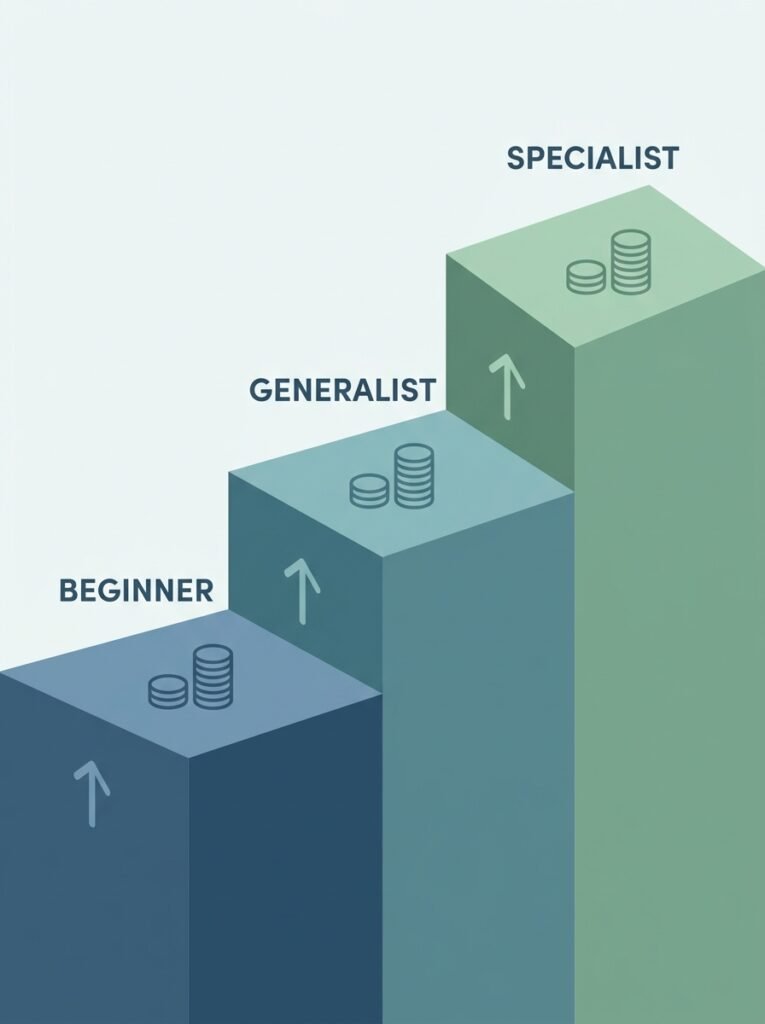
- Complete beginners on marketplaces like Upwork typically earn about $10–$20 per hour to start. Working 20 hours a week, that’s roughly $800–$1,440 a month.
- Generalist VAs with a little track record settle around $15–$25 per hour (consistent with PayScale/Indeed 2025–2026 data).
- Specialised VAs — those with in-demand skills like advanced spreadsheets, a specific CRM, bookkeeping, or a healthcare/real-estate niche — can command $35–$60+ per hour.
Two honest caveats. First, “no experience, six figures” is misleading; you are competing with people who may have admin backgrounds or existing clients, so treat the early phase as skill-building, not instant income. Second, your rate rises fastest when you specialise. A generalist stays near the floor; a “Shopify order-management VA” or an “inbox-zero VA for coaches” charges more because the outcome is specific.
How to actually start in 90 days (a real plan)
You don’t need a website, a big following, or savings. You need a focused offer and consistency.
Weeks 1–2: Pick and prepare. Choose two or three services you can genuinely deliver today (e.g., inbox management + scheduling + basic social posting). Install the core tools and learn their basics. Write a clear, specific profile — “I help busy coaches reclaim 5 hours a week by managing their inbox and calendar” beats “hardworking VA available.”
Weeks 3–4: Build proof. Create two small portfolio samples — even mock projects (a sample inbox-triage system, a sample content calendar). If you can, run one short, scoped “trial” project for a small business or creator and document the before-and-after.
Weeks 5–8: Apply with signal, not noise. Instead of mass-applying, send fewer, customised proposals that name the client’s specific problem and how you’ll solve it. Make sure your resume/profile contains the exact keywords in the posting (“calendar,” “scheduling,” “inbox”) so it passes automated filters.
Weeks 9–12: Land and stabilise. Your first client typically comes within a few weeks of consistent daily applications. Once you have one, ask for a testimonial, then move toward a monthly retainer (for example, a set fee for 20 guaranteed hours) — retainers smooth your income far better than one-off gigs.
Where to find legitimate VA jobs
- Freelance marketplaces: Upwork and Fiverr are the most common starting points for beginners — high competition, but real, verifiable clients and payment protection.
- Remote job boards: general remote-work boards regularly list part-time and full-time VA roles.
- VA agencies: agencies recruit and place VAs with vetted clients; you trade a cut of the rate for a steadier pipeline.
- Direct outreach: many small businesses need help but haven’t posted a listing — a polite, specific pitch can win work with no competition at all.
Who this does NOT work for
Straight talk saves you months:
- You want guaranteed, immediate high income. Early VA pay is modest; the money grows with proof and specialisation.
- You can’t self-manage. You’ll set your own hours, invoice clients, track your own taxes, and enforce your own boundaries. It’s a one-person business, not a remote office job.
- You have unreliable internet or device access. The work is fully online; connectivity is non-negotiable.
- You dislike admin and communication. These are the core of the job, not a side part of it.
How to avoid virtual assistant scams
The demand that makes VA work attractive also attracts fraud. Protect yourself:
- Never pay to get a job. Legitimate clients and agencies don’t charge you a “registration,” “training kit,” or “starter” fee. Money flows to you, not from you.
- Beware overpayment and check scams. If a “client” sends you a cheque for more than agreed and asks you to refund the difference or buy gift cards, it’s a classic scam — walk away.
- Verify the client and use the platform’s protection. On marketplaces, keep communication and payment on-platform; taking a new client “off-platform” immediately removes your protection.
- No one can guarantee a specific income. “Earn $5,000 in your first month, guaranteed” is a red flag, every time.
- Guard your data. Don’t share bank logins, passwords or OTPs; a real client never needs those to pay you.
Key Takeaways
- Virtual assistant work is a legitimate, growing 2026 remote path — no degree, low barrier, real demand (Upwork ranks it among top freelance skills).
- Beginner pay is honest, not huge — roughly $10–$20/hour to start, $15–$25 as a generalist, $35–$60+ specialised.
- The core skills are inbox management, scheduling and clear communication — master those first.
- Start with two services, a small portfolio, and customised applications; your first client usually comes within a few weeks of consistency.
- Never pay to get a job, keep payments on-platform, and treat any income “guarantee” as a scam.
FAQ
1. Can I become a virtual assistant with no experience in 2026? Yes. Most beginner VA roles are entry-level, and clients care more about reliability, communication and tool fluency than a degree. Start with two services you can deliver, build a small portfolio, and apply consistently — your first client usually comes within a few weeks.
2. How much do beginner virtual assistants earn? Beginners on platforms like Upwork typically earn about $10–$20 per hour to start, or roughly $800–$1,440 a month at 20 hours a week. Generalists settle around $15–$25, and specialised VAs can earn $35–$60+ per hour.
3. Do I need a degree or certification to be a VA? No. There’s no mandatory degree or certification. A clear profile, a couple of portfolio samples, strong communication and fluency with common tools (email, calendar, project-management and AI tools) matter far more.