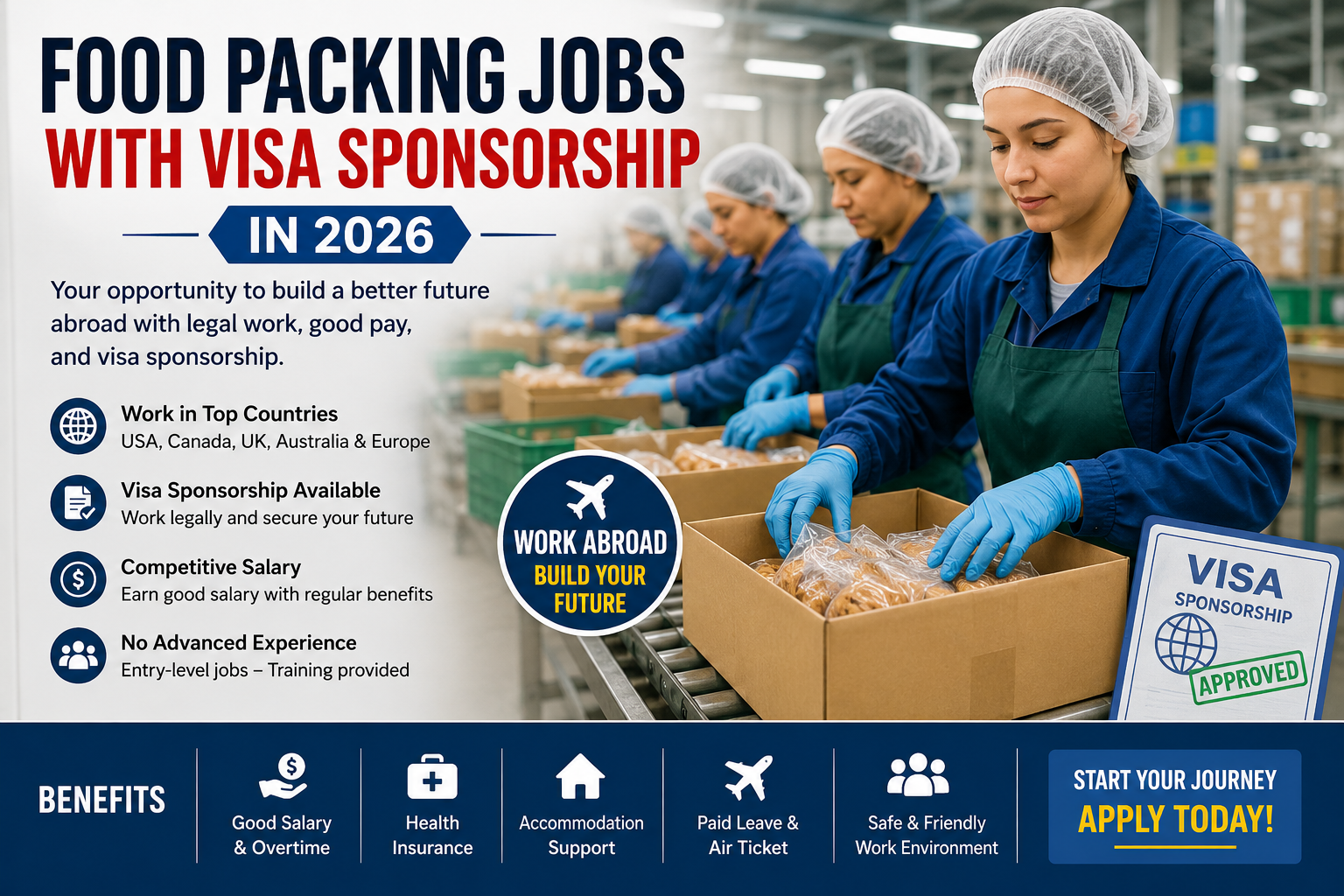
Looking for a stable and rewarding job overseas can be difficult, especially in the midst of greater competition for jobs overseas in 2026. Food packing jobs with visa sponsorship are one of the most accessible and sought-after industries to pursue overseas work. These jobs pay well and the workers have the opportunity to get international experience, to work in safe and structured environments, and they may also receive other bonuses like accommodation and travel assistance.
In this article, you’ll find all information you need regarding food packing jobs sponsored by the Canadian government in 2026. The essentials of these positions, entry qualifications, how to apply step-by-step, tips to increase your chances, common pitfalls to avoid, and frequently asked questions will be covered. At the end of the course, you will have a clear course map to have a safe and successful food packing venture abroad.
Overview of Food Packing Jobs
The food packing sector is a crucial industry in agriculture and food processing, which is important all over the world. Food Items are sorted, packed and labeled by workers to meet the International safety and quality standards. Here are some of the industries where they can be found:
- Fresh fruit and vegetable packing
- Meat and poultry processing
- Frozen food packaging
The packaging of snacks, sweets, and candies. Packaging for Snacks and Confectionery.
Dairy product handling
When a visa is sponsored, the employer is responsible for securing visas and legal paperwork, allowing foreign employees to move more easily to the new country without legal difficulties. It is especially popular in countries such as the UK, Canada, Australia and the Gulf states.
Who Should Consider Food Packing Jobs?
Food packing jobs are ideal for individuals:
- Seeking entry-level positions abroad
- Looking for stable income with accommodation benefits
- Interested in gaining international work experience
- Able to perform repetitive tasks with attention to detail
- Physically fit to handle standing for long hours or light lifting
Key Highlights of Food Packing Jobs With Visa Sponsorship
Securing a food packing job with visa sponsorship comes with multiple advantages:
- ·Work permit: Employers are responsible for processing all work permit paperwork.
- Accommodation and Travel: This is where some firms provide free or subsidised accommodation and travel.
- ·Competitive Salary: Depending on the country, workers can earn between $1,500 to $3,000 per month.
- Job Security: Food is a continual demand and thus a perpetual job.
- Skill Development: Quality control, safety and teamwork skills are developed.
- Opportunities for Advancement: There are opportunities for advancement for long term employees into supervisory or warehouse management positions
- These highlights make food packing jobs a viable career choice for young people and those looking for work abroad in 2026.
Requirements and Eligibility Criteria
Before applying, it is essential to understand the eligibility criteria. Most employers and visa programs will require:
Age Limit
- Typically between 18–40 years old.
- Some programs may extend the limit to 45 for experienced workers.
Educational Requirements
- Minimum high school diploma or equivalent.
- Some employers accept candidates with only basic literacy.
Health and Fitness
- Physically able to perform repetitive tasks, lift 10–20 kg packages, and stand for extended periods.
- Medical fitness check may be required before visa approval.
Work Experience (Optional)
- Prior experience in food processing, warehouse, or factory work is beneficial but not always required.
Language Skills
- Basic English or local language proficiency depending on the country.
- Communication skills are necessary for understanding safety protocols and instructions.
Documentation
- Passport with at least six months validity.
- Police clearance certificate (if required by the country).
- Recent passport-sized photographs.
- Visa sponsorship documents provided by the employer.
How to Apply – Step-by-Step Guide
Applying for a food packing job with visa sponsorship involves several steps. Follow these guidelines to improve your chances:
Research Companies and Programs
- Look for reputable agencies offering food packing jobs with visa sponsorship.
- Verify the company’s legitimacy through official websites or government labor portals.
Prepare Your Documents
- Ensure your passport, CV, medical certificates, and educational documents are ready.
- Include references if possible.
Submit Your Application
- Apply through official recruitment portals or verified agents.
- Fill out application forms accurately, highlighting relevant skills and experience.
Attend Interviews or Assessments
- Some employers conduct virtual interviews.
- Prepare to answer questions about your experience, work ethic, and availability.
Visa Processing
- Once selected, the employer initiates the visa sponsorship process.
- Follow instructions for submitting documents and completing medical or background checks.
Travel and Orientation
- After visa approval, the employer arranges travel and onboarding.
- Attend orientation sessions to learn safety protocols, packing standards, and workplace rules.
Benefits of Working in Food Packing Jobs Abroad
Working in a food packing job with visa sponsorship offers several advantages:
Steady Income
- Food industries operate year-round, ensuring consistent pay.
Accommodation and Travel Support
- Employers may provide free or affordable housing.
- Travel expenses may be partially or fully covered.
International Work Experience
- Working abroad enhances your resume and future employment prospects.
Skill Development
- Learn food safety standards, warehouse management, and teamwork.
- Gain exposure to modern packing machinery and logistics systems.
Career Advancement
- Long-term employees can progress to supervisory roles or move into logistics and quality control.
Tips and Expert Advice for Applicants
- Early: some programs fill up fast – make applications months ahead of time.
- Check their Visa Sponsorship Details: Make sure the visa sponsorship is genuine.
- Food packing jobs are physically demanding and require a lot of stamina and endurance.
- Stay Organized: Ensure all documents/certificates are available in both physical and digital format.
- Research Country Regulations: Identify labor regulations, minimum wages and workers’ rights in the country of destination.
- Be professional: Be on time, punctual and committed to your job to boost your chances of getting promoted.
FAQs
Do all food packing jobs provide visa sponsorship?
No, only specific programs or companies offer visa sponsorship. Always verify before applying.
Is prior experience necessary?
Not always. Entry-level positions are available, but experience may improve your chances.
Are food packing jobs physically demanding?
Yes, you may need to stand for long hours, lift packages, and work in a fast-paced environment.
Which countries offer the most opportunities in 2026?
The UK, Canada, Australia, New Zealand, and Gulf countries have high demand for food packing workers.
What benefits can I expect besides salary?
Accommodation, transportation, healthcare, and sometimes meals or overtime pay.
Conclusion
Packing jobs in the food industry have visa opportunities and are a great job to have in 2026. They provide legal work permits, consistent pay, housing support and skill development opportunities. Knowing what’s involved, taking a step-by-step approach to the application process, and avoiding common errors can help you land a great job overseas.
From your first job to your international experience, food packing careers are attainable and practical. Get ready now, do your research, and check out these savvy tips for a smooth ride.
Types of Food Packing Jobs
Expanding your knowledge about the variety of roles helps readers see opportunities clearly:
Fresh Produce Packers
- Sort and pack fruits and vegetables for export or local markets.
- Check for bruised and spoiled items – make sure they are quality controlled.
- Typically involves standing for extended periods of time and operating light boxes.
Meat and Poultry Packers
- Involve cutting, trimming and packing meat.
- Needs to follow hygiene and safety procedures very strictly.
- Safety: Gloves, apron and hairnets usually required, refrigerated facilities.
Frozen Food Packers
- Pack ready-to-eat meals, frozen vegetables and seafood.
- Working in cold storage areas, gloves and insulated clothing must be worn.
- Working at a rapid pace to produce quotas.
Snack Confectionery Packers
- Packaging chocolate, candy, biscuits and other processed foods.
- Includes labelling, sealing and integrity checking of packaging.
- Needs to pay attention to detail to prevent quality or labeling errors.
Dairy Product Packers
- Handle milk, cheese, yogurt and other milk products.
- Must adhere strictly to hygiene measures to avoid contamination.
- Some manual labor required for packaging; Machines can help.
Countries with the most promising futures in 2026
Visa sponsorship is dependent on the country where you are going. Here’s a breakdown:
United Kingdom (UK)
High demand of seasonal fruit pickers and food packers.
- Visa: Seasonal Worker Visa (6 months) or Skilled Worker Visa (long-term).
- Benefits: Accommodation usually provided, competitive salary plus overtime.
Canada
- Agricultural and factory food packing jobs common in Ontario and British Columbia.
- Temporary Foreign Worker Program (TFWP) with an employer.
- Benefits: Legal work status, health care insurance and sometimes flights along with it.
Australia
- Packing fresh produce in oFood packing plants, fresh produce cold storages.
- The Temporary Skill Shortage (TSS) Visa or Seasonal Worker Program is called oVisa.
- Benefits: Government imposed minimum wage, accommodation facilities.
- From the Gulf Countries (UAE, Saudi Arabia, Qatar):
- Jobs in local markets of warehouses and processing plants.
- Employer-arranged work visa sponsorship (ovisa).
- Benefits: No tax, housing may be included, and travel allowance.
New Zealand
Fruit packing, dairy and meat packing are popular oSeasonal occupations.
- Visa: Recognised Seasonal Employer (RSE) Scheme.
- Benefits: Accommodation, guaranteed wages, opportunity to stay longer with rehire.
Salary Expectations and Cost of Living
Realistic income is a key planning point to take into consideration:
- ·UK: £10–£13 per hour; £1,500–£2,000/month. Seasonal jobs may be more lucrative and offer overtime opportunities.
- ·Canada: CAD 16–20 per hour; CAD 2,000–2,500/month.
- ·Australia: AUD 20–25 per hour; AUD 2,500–3,000/month.
- In the Gulf countries, they pay $400-700/month with your accommodation, and $800-1200 for more skilled packing jobs.
- Always ask about food and housing provided by the employer as it would be a huge help in lowering the expenses of living.
Safety, Hygiene and Working Conditions
There are very strict safety and hygiene requirements that must be met for food packing occupations:
- The wearing of gloves, hairnets and masks.
- Caring for clean work stations and preventing contamination.
- Learning responsibilities for handling hazardous materials, including knife safety, machinery handling.
- Insulated uniforms may be necessary when working in cold storage.
- Onboarding is where employers will frequently include safety training.
Long-Term Opportunities and Career Growth
Even entry-level food packing jobs can lead to career advancement:
- Shift Supervisor Oversee packing teams, manage schedules, ensure quality standards.
- Quality Control Inspector Inspect food for contamination, packaging errors, or labeling mistak
Tip: Documenting work experience and skills abroad strengthens your resume for higher-paying roles in the future.
Legal Considerations and Workers’ Rights
In case of employment abroad:
- Please verify legal working hours and overtime for your visa.
- Understand minimum wage laws and payment schedules.
- Verify health and accident insurance.
- Know worker grievance procedures in case of disputes.
- Don’t deal with agencies that require payment in advance; visa sponsorship jobs are free to apply for.
Expert Tips to Increase Your Chance
- Only apply to verified agencies – to avoid scams and fake jobs.
- Create a Clear CV – emphasize packing or warehouse duties and quality control.
- Develop Basic Language skills – English or local language for improved communication.
- Maintain Physical Fitness – you will need to be physically fit to stand for prolonged periods or to lift boxes.
- Be reliable – punctual and consistent.
Top 8 Mistakes to Avoid
- Using unverified recruitment agencies.
- Submitting incomplete documentation.
- Failure to uphold local laws and work safety rules.
- Misjudging the physical activity involved in food packing.
- Considering visa restrictions such as hours of work or length of time.